Own Delivery Storefront vs Swiggy and Zomato: Do the Arithmetic
A worked method for comparing aggregator commission with your own delivery storefront, using your numbers instead of somebody else's savings claim.
The honest comparison between an aggregator and your own delivery storefront is not a percentage you read on a marketing page. It is an arithmetic you do once, with your own settlement statement, your own order mix and your own delivery cost. This post gives you that method, and then the parts of the decision that arithmetic cannot settle.
We are not going to tell you that restaurants save a specific amount. Anyone who does is guessing at your contract.
What are the two models?
The aggregator model. Swiggy and Zomato bring you a customer who was browsing an app, take the order, arrange the rider, and settle the money to you after deducting commission, payment charges, and whatever discount programme you are enrolled in. You get volume and discovery. They own the relationship, the phone number and the ranking that decides whether the customer sees you at all.
The direct model. You publish your own ordering page, share the link yourself, and take the order on your own system. You get the margin and the customer record. You are responsible for demand and for getting the food to the door.
The argument between them is not new. What is usually missing is the number.
What does each one actually cost you?
Stop reading a rate off a page. Your effective rate is a division, not a headline.
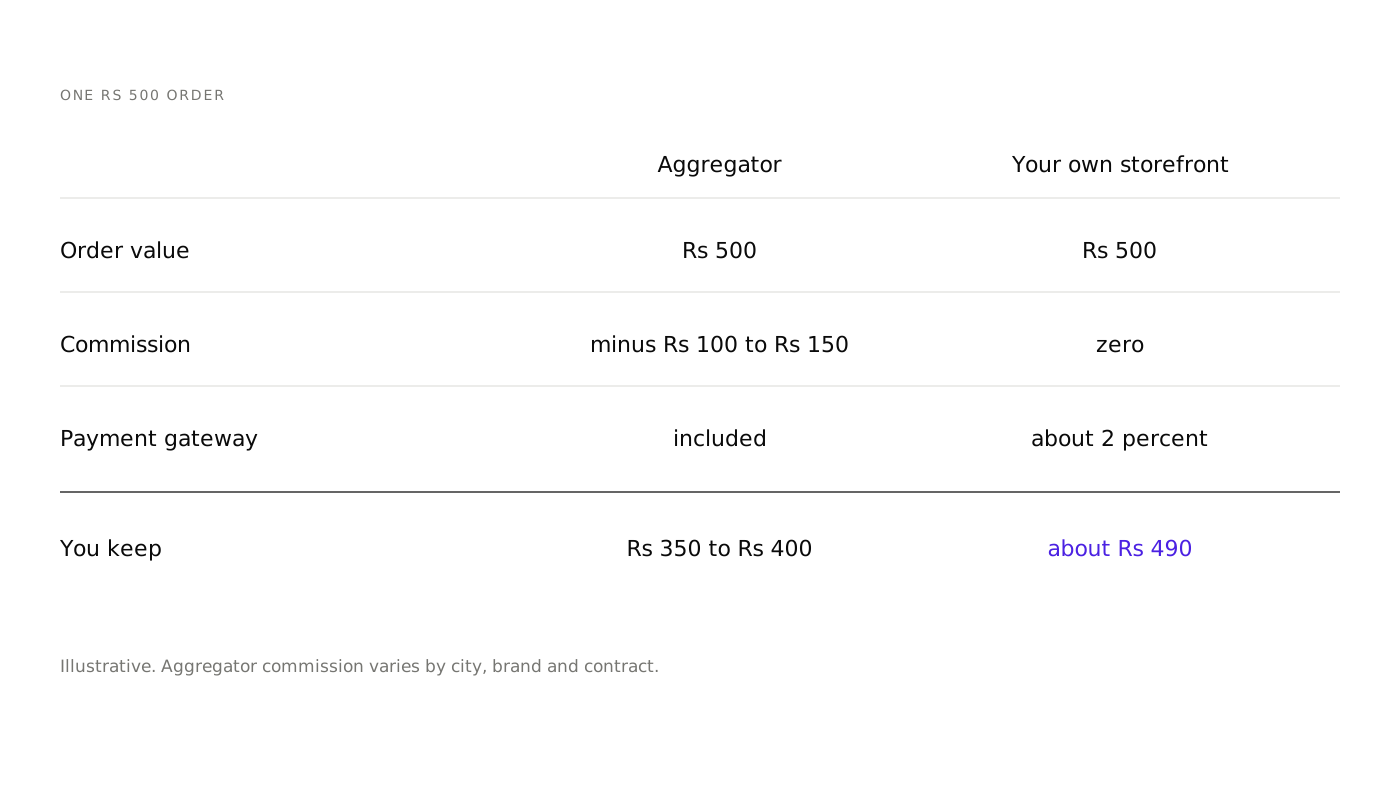
Step one: your real aggregator rate. Take one full month of aggregator settlements. Add the gross order value of every order. Add what actually landed in your bank. Divide the second by the first, subtract from one, and that is your effective take rate. It will be higher than the commission number in your contract, because it includes payment charges, the discount funding you agreed to, and any advertising you bought.
Step two: your direct cost per order. Add the platform fee on a direct order, the payment charge, and your delivery cost. For Muncho that is 5 per cent on a delivery order, plus what it costs you to get the food there. If your own staff deliver, cost the rider time honestly, including the hours they are waiting. If a partner delivers, use their per-order quote.
Step three: the demand discount. This is the one people skip. Multiply the direct cost by the orders you would actually get on your own channel, which is not the same as the orders you get on the aggregator. Be pessimistic in month one.
Step four: compare per order, not in total. Take the amount you keep on a typical order in each model.
| Line | Aggregator | Direct storefront |
|---|---|---|
| Order value | Your average, from the settlement statement | Your average |
| Platform take | Your effective rate from step one | Muncho platform fee on the order type |
| Payment charge | Usually inside the effective rate | Your Razorpay rate |
| Delivery cost | Included | Your rider cost, or a partner quote |
| Discount funding | Whatever you agreed to | Whatever you choose to run |
| What you keep | Order value minus the above | Order value minus the above |
The direct delivery page on this site runs the same sum in a small calculator, with a stated assumption that aggregators take 25 to 30 per cent. Treat that as a starting point and replace it with your own figure from step one. If the answer looks worth testing, open an account and run one real order through your own link before you change anything with the aggregator.
Who owns the guest?
The number is only half the decision, and often not the important half.
On an aggregator order you know that somebody ordered a biryani. You do not reliably get a phone number you can use, and you cannot tell that guest anything directly.
On a direct order the record is yours. The Customers section in the dashboard lists the order with the name, the phone number, the payment and the total, and the detail sheet shows a taste profile and favourites. Two caveats worth knowing before you get excited: the list is one row per order rather than a deduplicated customer, and there is no tagging feature. It is a record, not a full CRM.
What you can do with it today is transactional. Guests get WhatsApp messages for order accepted, order ready and order cancelled, plus payment links and receipts. There is no broadcast or campaign builder in the dashboard, so if you were picturing a marketing blast, read what WhatsApp messages your guests actually get before you plan around it.
What do you give up by going direct?
Three real things, and pretending otherwise helps nobody.
Discovery. Nobody opens your website when they are hungry and undecided. They open an app. A direct storefront serves people who already chose you.
The rider network. Aggregators have one. You either have staff who can deliver or you buy a partner. Muncho supports your own staff or Shiprocket, with live rider tracking, an AWB and a courier name on the order, and a tracking link for the guest. Shiprocket is configured by the Muncho team during onboarding; there is no self-serve connect screen.
The default. An aggregator listing keeps working while you sleep. A direct channel only works as hard as you push the link.
How do most restaurants actually run this?
Both at once, with a deliberate split.
Aggregators do the job they are good at: putting you in front of somebody who has never eaten your food. The direct storefront does the job they are bad at: serving the regular who already knows exactly what they want and would rather not pay a platform for the privilege.
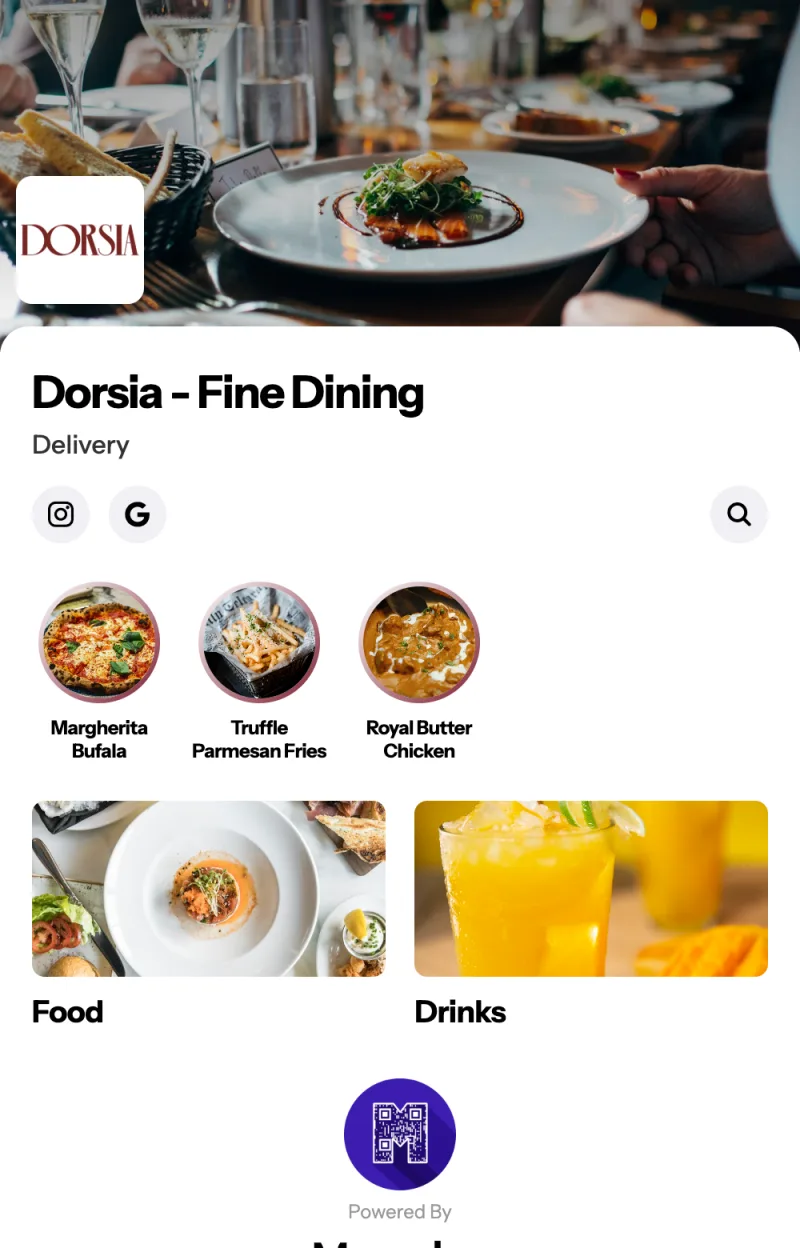
The practical mechanics are simple. Your direct channel gets its own link, which the dashboard gives you on the Links page. There is a per-channel link for delivery and pickup, and a Main link that offers every channel and lets the customer pick, described in the dashboard as the one to use anywhere you only get one link. Put that link in the Instagram bio, on the Google Business profile, on the takeaway bag sticker and at the bottom of the bill.
Then measure. If the direct channel is a tenth of your delivery volume after three months, the arithmetic above is still working in your favour on those orders, and the question is distribution, not the platform.
What do you need to launch a direct storefront?
- A menu in the system. See how your menu gets into Muncho.
- A payment account, so guests can pay online. See Razorpay for restaurants.
- Delivery rules. A radius, a charge, and a packaging charge. Set them on the Delivery Settings page, described in delivery charges and radius. Be aware there are no delivery zones or polygons, only one radius, and no minimum order value.
- A pickup channel too, usually. It costs nothing extra and it is the cheapest order you will ever take. See pickup and takeaway ordering.
- Somewhere to put the link. This is the part that decides whether it works.
Is it worth it?
Run steps one to four on last month's numbers before you decide. If your effective aggregator rate turns out to be near the bottom of the range and you have no way to reach your regulars, the direct channel is a slow build. If it is near the top and you already have a following on Instagram or a busy counter, the arithmetic usually answers itself on the first page.
India plans are annual per outlet, plus GST: Plus Rs 11,999 and Pro Rs 23,999. Delivery usage comes from your wallet at 5% plus rider at cost, and the delivery fee only applies when an order comes through.
Questions restaurants ask
How much commission do Swiggy and Zomato charge?
It varies by city, cuisine, contract and the discount programmes you have opted into, so the only rate worth using is the one on your own settlement statement. Take one month of payouts, divide the amount you received by the gross order value, and you have your real effective rate.
What does Muncho charge on a delivery order?
Five per cent on delivery orders, and 2.1 per cent on pickup, dine-in, pay-first, events and cover charge. You choose whether the guest or the restaurant bears that fee, on the Commission card of each Settings page.
Will I lose orders if I leave the aggregators?
Probably, and that is the honest case against going direct only. Aggregators are a discovery channel. Most restaurants run both: aggregators for new customers, a direct storefront for the ones who already know you.
Who delivers the food on a direct order?
Your own staff, or Shiprocket, which is set up by the Muncho team during onboarding. There is no self-serve connection screen for it yet.
Do I keep the customer's phone number on a direct order?
Yes. Direct orders create a customer record in your dashboard with the phone number, the order history and a taste profile. Note that Muncho does not save delivery addresses, so a repeat guest re-enters the address each time.
Run this on your own menu
QR ordering at the table, your own delivery and pickup storefront, and payments straight to your account. India plans: Plus Rs 11,999, Pro Rs 23,999, Max Rs 49,999 a year per outlet, plus GST. Usage comes from your wallet.
Sources
- uEngage, Restaurant Online Ordering vs Aggregator Platforms, accessed 2026-09-19
- owner.com, Local SEO for Restaurants, accessed 2026-09-19
- Muncho direct delivery page and its savings calculator, accessed 2026-09-19